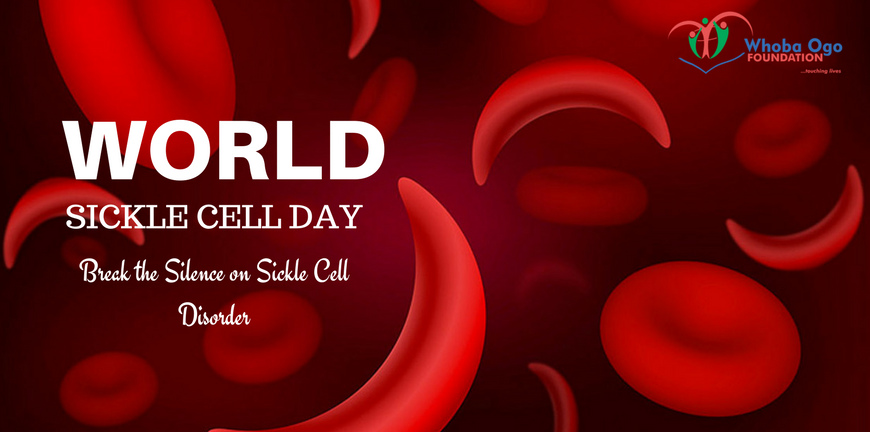
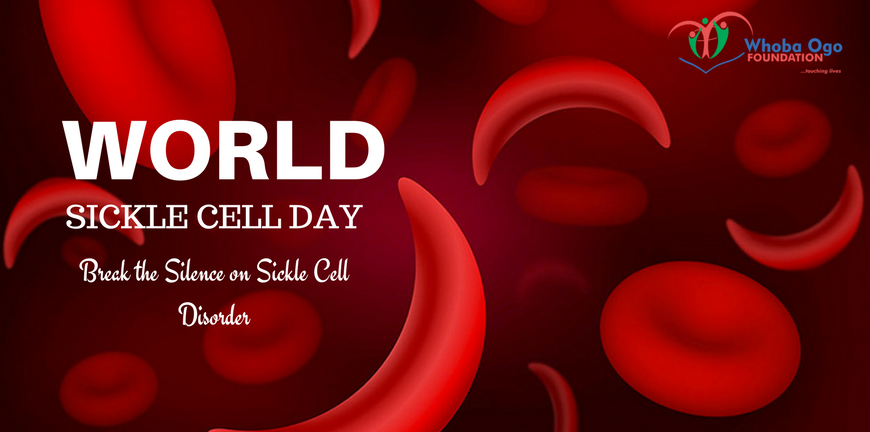
Hi! Today is the 19th of June this year, and just like every year, it is a very special day which has been set aside for a very special purpose. Its ‘World Sickle Cell Day’.
What is Sickle Cell Disease?
If you had the nature of exposure I had while growing up, you would quickly associate the term ‘Sickle Cell’ to some quiet and sickly primary school classmate who frequently missed school for days in a row for seemingly mysterious reasons. Well, for quiet a long time, that is the much I knew about the Sickle Cell Disease (SCD). But now I know there is much more to this disease that just a quiet and fragile child.
Sickle cell anemia (sickle cell disease) is a disorder of the blood caused by an inherited abnormal hemoglobin (the oxygen-carrying protein within the red blood cells). The abnormal hemoglobin causes distorted (sickled) red blood cells. The sickled red blood cells are fragile and prone to rupture. When the number of red blood cells decreases from rupture (hemolysis), anemia is the result. This condition is referred to as sickle cell anemia. The irregular sickled cells can also block blood vessels causing tissue and organ damage and pain.
Sickle Cell Disease affects millions of people around the world, including both adults and children. It is a potentially fatal disease and, according to the World Health Organization (WHO), is one of the main causes of premature death amongst children under the age of five in various African countries. Sickle cell disorder is by far the commonest inherited disorder in the world and three quarters of cases occur in Africa. In Nigeria, where it affects two out of every hundred children born, it causes suffering for innumerable patients and their families.
Sickle cell disease is common among the African, Asian nations and amongst people who do not have access to proper medical supervision and care. In the United States mainly the African-Americans are affected, with every one in 500 African-American child being affected with the disease. In Africa nearly 2% of newborns are affected with sickle cell disease. In the United Kingdom more than 200 newborns are infected with sickle cell disease. In the Middle East more than 6000 babies are born annually with sickle cell disease.
Why Do We Have A World Sickle Cell Day?
In the year 2008, the General Assembly of the United Nations adopted a resolution which determines sickle cell disease as a public health problem and one of the world’s foremost genetic disease, requiring heightened awareness and activism, diagnosis and management. The result of the resolution was that June 19th was declared as World Sickle Cell to increase awareness of the condition all over the world.
The World Health Organization (WHO) has started work on a war footing to promote a world-wide agenda to address hemoglobin dysfunctions.
WHO has made a commitment to:
⇒Recognize that sickle cell disease is a major health issue.
⇒Increase awareness of the world community regarding sickle cell disease.
⇒Eliminate harmful and wrong prejudices associated with sickle cell disease.
⇒Urges member countries where sickle cell disease is a public health problem to establish health programs at the national level and operate specialized centers for sickle cell disease and facilitate access to treatment.
⇒Promote satisfactory access to medical services to people affected with sickle cell disease.
⇒Provide technical support to all countries to prevent and manage sickle cell disease.
⇒Promote and help research to improve the lives of people affected with sickle cell disease.
The World Sickle Cell day is celebrated across the globe with special emphasis in African Nations and Asia. The celebrations include a press, media campaigns, music shows, cultural activities, and talk shows.
Since no known cure exists for sickle cell disease, the main goal is to prevent further complications due to sickle cell disease. The main emphasis is hence on educating medical professionals, care givers, and associated personnel about prevention, research, and resources to minimize the complications due to sickle cell disease. Hence June 19th is devoted mainly to spread awareness, through talks, seminars, pamphlets, literature and consultations.
Is There Hope?
Yes! There is hope. Other diseases such as small pox, Yellow Fever, Polio etc have threatened us as humans at some time or the other in time past. We have fought these diseases down to minimum. I believe this is not going to be an exception.
The major weapon we need to win this war is INFORMATION. With adequate information, potential parents can make informed decisions regarding their Sickle cell status and that of their unborn children. Since this disease is genetically transferred, the responsibility lies in the hands of potential parents to choose their partners with the future of the children in mind.
Comments (0)
No comments yet. Be the first to comment!